Visionary Trollope

If you want to have a nice lie-down on the fainting couch every time politics pops up in general conversation, here’s a superior prescription: English novelist Anthony Trollope.
For dragging the 21st century into his own time — or his time into ours — it’s hard to beat Trollope. Diving into a Victorian novel may sound counterintuitive for these times, but recognizing that Trump could have been a Trollope character is weirdly comforting.
I’ve been devouring his novels on and off for years — thinking there might be some escape to be had in a fictional England of yore — but I had underestimated him. It is very nearly as though Trollope had invented this president: all that short-sightedness and frantic toddler propensity towards distraction and that limitless, titanic self-regard turn out to be elements of a variety of Trollope’s characters.
Trollope has a profound understanding of how we wend our way through life: telling ourselves little lies, comforting ourselves with rituals and cliché, and — in the positive realm — extending ourselves past our own limits to serve those we love: all of it, the gorgeous and the cave-dark.
The bad stuff in Trollope, as in life, is really, really bad. Yet when events leap from tedious to horrifying to shocking to please-let-it-just-be-stupid-and-not-world-changing, there’s a bracing, astringent relief to be reminded that there is nothing new under the sun.
Trollope wrote, “A small daily task, if it be really daily, will beat the labours of a spasmodic Hercules.” This described his writing habits, and that ongoing quest to perfect his craft translates into characters whose foibles are so ancient — and so recognizable — that it is nearly a physical shock to see them spring, living and fresh, from a pen wielded well over a century and a half in the past.
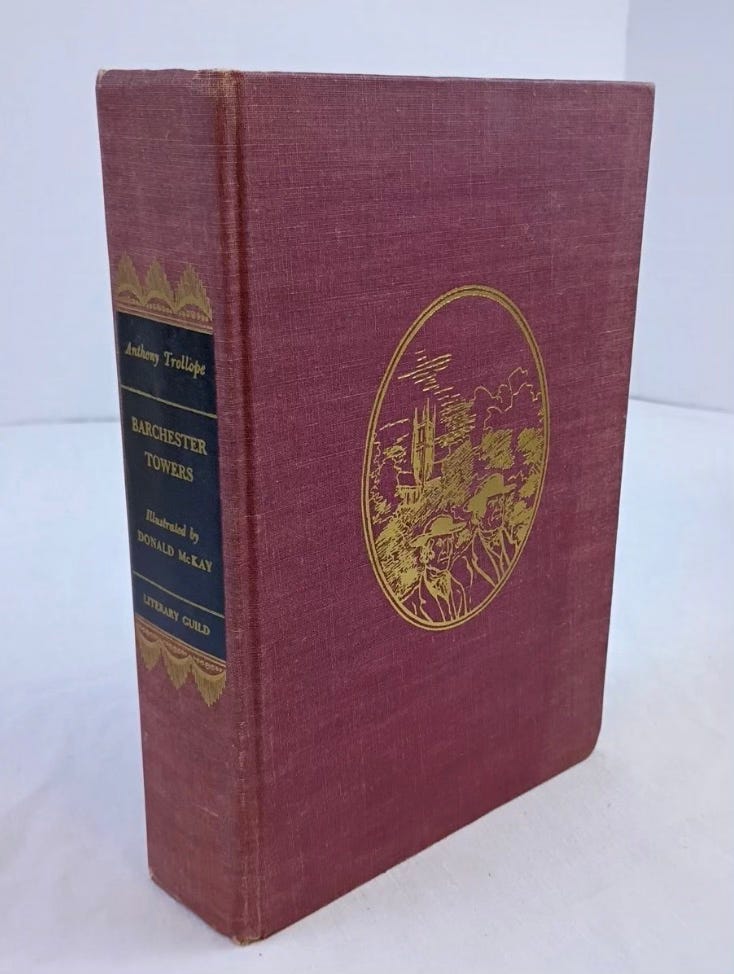
I am happy to report that according to our trusted guide, this too shall pass. Witness this, for instance, from Trollope’s 1857 novel Barchester Towers:
“New men are carrying out new measures, and are carting away the useless rubbish of past centuries!”
What cruel words these had been: and how often are they now used with all the heartless cruelty of a Slope [a scheming chaplain]! A man is sufficiently condemned if it can only be shown that either in politics or religion he does not belong to some new school established within the last score of years. He may then regard himself as rubbish and expect to be carted away.
A man is nothing now unless he has within him a full appreciation of the new era: an era in which it would seem that neither honesty nor truth is very desirable, but in which success is the only touchstone of merit. We must laugh at everything which is established. Let the joke be ever so bad, ever so untrue to the real principles of joking: nevertheless we must laugh — or else beware the cart.
We must talk, think and live up to the spirit of the times, and write up to it too, if that cacoethes* be upon us, or else we are nought. New men and new measures, long credit and few scruples, great success or wonderful ruin, such are now the tastes.
Or take this, from the 1870 novel The Vicar of Bullhampton — see if this reminds you of anyone who might be, perchance, head of one of the most powerful nations on earth:
Lord Trowbridge . . . was a silly man, thinking much too highly of his own position, believing himself entitled to unlimited deference from all those who in any way came within the rays of his magnificence, and easily made angry by opposition; [but] he did in some way recognise it as a duty attached to his splendour that he should try to be beneficent to the inferiors with whom he was connected.
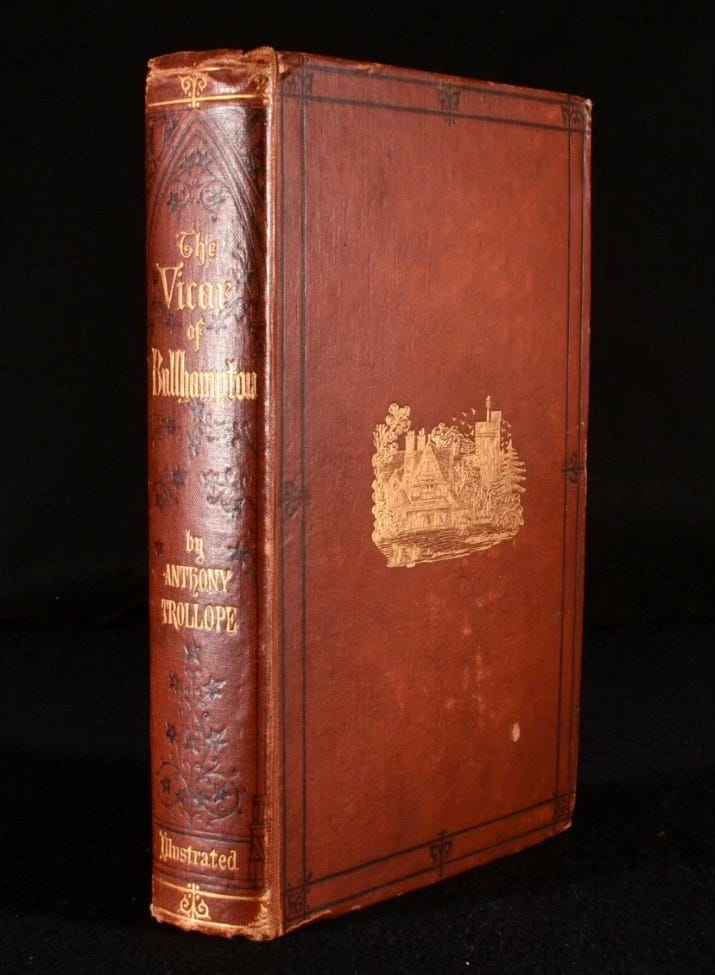
I defy you to decline recognition of virtually any Trump foe in the passage below, also from The Vicar of Bullhampton. Just substitute “president” for “marquis,” et voilà:
He did not intend to weave in any mercy towards the marquis. It behooved him to punish the marquis, for the good of society in general. As a trespasser he forgave the marquis, in a Christian point of view; but as a pestilent wasp on the earth, stinging folks right and left with an arrogance, the ignorance of which was the only excuse to be made for his cruelty, he thought it to be his duty to set his heel upon the marquis . . . It was his direct object to vex the marquis, and he set about it with all his vigour.
This can’t — and won’t — last forever. If all else fails, remember, Mr. Brattle’s succinct observation in The Vicar of Bullhampton: “There’s a deal of things is wanted as ain’t to be had.”
This is the 19th-century iteration of the Rolling Stones’s weary reminder that you can’t always get what you want. But via Trollope, heck, you may just get what you need.
*Pronounced ka-CO-eths. My goodness, what a great word! It means a well-nigh-irresistible itch to do something inadvisable.
“This too shall pass” - I am all for that Mr Visionary Trollope!
My late favorite professor wrote his PhD on Trollope a million years ago but I've never read him. Do you have an opinion on best one to read first? Thanks!